
A · Perception
GPS-denied vision — real-time track and pixel-error from the camera frame (Pi bench demo above; sim IBVS loop below).
Systems / Scythe
Scythe is the Track 1 guidance testbed: a 5" carbon FPV airframe with a Raspberry Pi 5 running YOLO + Δx/Δy at 180+ FPS. Below: the recorded bench demo (hardware) and the live IBVS simulator (simulation). Mapping pixel error to body rates is next—not field-deployed. High-speed aero work runs separately on Sprinter.
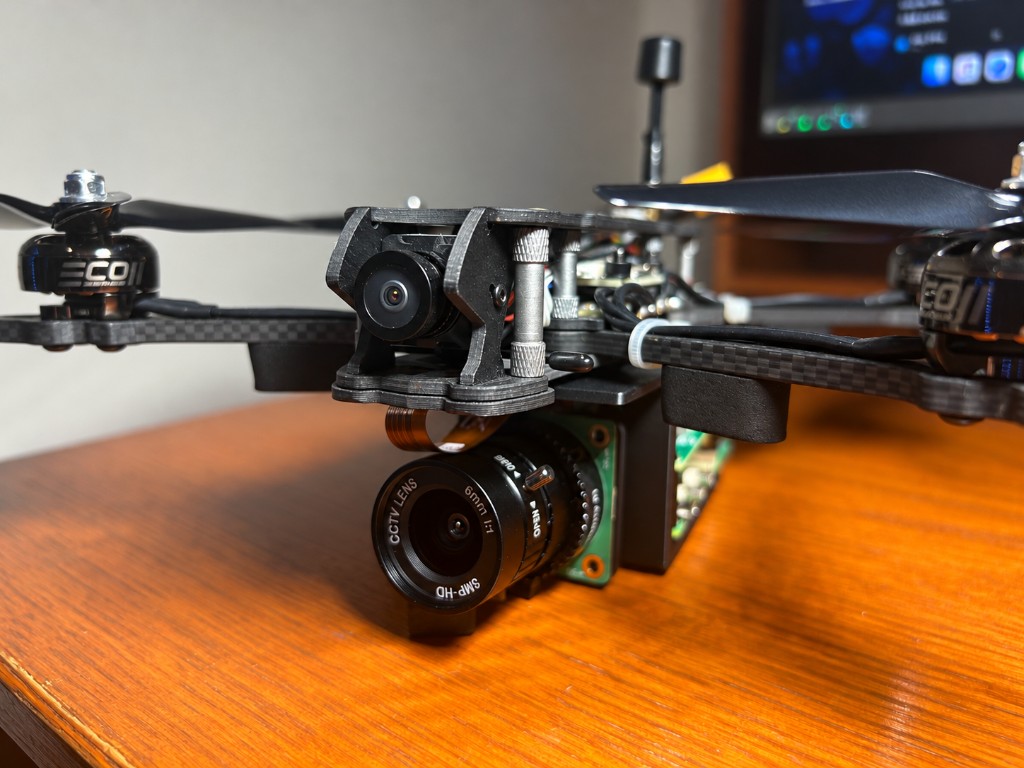
Hardware bench
The interceptor uses a vision-based perception and visual-servoing pipeline to detect and track aerial targets. This Track 1 bench / Scythe stack demonstrates real-time YOLO detection and image-plane pixel error (Δx, Δy) at 180+ FPS—the feedback signal for the guidance loop. Detection and error generation only; rates not closed to motors yet.
Simulation view
The same visual-servoing loop, shown from the command picture and the seeker. Left: top-down pursuit geometry. Right: simulated onboard camera driving pixel error toward zero.
Browser IBVS simulator · Command picture + seeker view · Shared telemetry bus
Last arrow = next milestone · not closed on hardware yet
A · Perception
GPS-denied vision — real-time track and pixel-error from the camera frame (Pi bench demo above; sim IBVS loop below).
B · Guidance
Terminal guidance research for intercept trajectories—aerial and ground-target scenarios—without a human FPV pilot on the final approach.
C · Integration
One software architecture supports multiple scenario classes in simulation—reducing duplicated research paths across air and ground-target studies.
Next system
Sprinter: the high-speed airframe that will carry this guidance stack.